Troy McClure
Member
I started by replying to an old thread where people had given up changing their clutch master cylinder, but thought I might start a new thread for anyone looking to do it. Apologies there aren't more photos - I struggled with this over three days on and off and photos were the last thing on my mind. Reckon I could do it in a few hours now I know what to do though. Expect to alternate between hands and knees outside the car, lying on your side reaching with your left hand, right hand holding the roof of the car and lying on your back with your head in the pedal box. You may consider removing the driver's seat (disconnect the battery negative first to avoid SRS issues when you disconnect the airbag connector), but I managed with the seat moved all the way back, albeit with a lot of bruises. This seemed a simple job but I've had easier engine removals tbh.
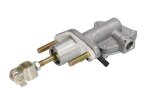
My symptoms: First, the clutch was squeaky. Then while holding on the clutch for any length of time in traffic, I noticed the biting point got closer to the floor to the point I almost stalled a couple of times. Suspected a small internal leak. No loss of fluid but it was very black and bitty in the reservoir suggesting the seals in master or slave or both were failing. I've had a couple of occasions in my life where I've had to continue my journey with no clutch but I'm not a student any more; I ordered both just in case. Master: ABE F94006ABE (about £45), Slave: Ashika 85-04-412 (just under £25).
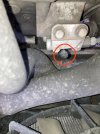
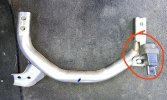
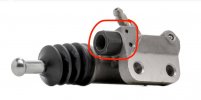
1. Drain the fluid, at least from the top half of the system by attaching a siphon tube to the bleed valve on the slave cylinder (marked in red). Open the cover of the reservoir, run the tube to a suitable container, crack the bleed open (8mm) and wait. If your clutch pedal still works, you can pump it to speed up the process. You'll want the clutch reservoir empty at least, plus probably the same again to avoid too much leakage - DOT 4 brake fluid strips paint so wash away any spills quickly.
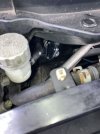
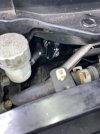
2. Remove the strut brace (three nuts each side) and the clutch reservoir mounting bracket to give you space to reach in there - there's a hose held by a couple of clips to the strut brace that you can tuck under the engine cover to keep it out of your way. Photo shows master cylinder, reservoir and pipe clipped to strut brace in foreground.
3. Remove the trim under the dash and on the side of the centre console to the left of the clutch pedal. Both are just held by clips; the one under the dash has a connector for the blue footwell LED.
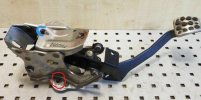
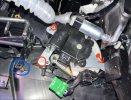
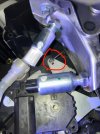
4. There are two 12mm nuts in the footwell that hold the master cylinder in place. The one in the 5 o'clock position is easy to get to with a UJ and extension (wrap the UJ in insulation tape to limit its movement to help position it on the nut), the one at 11 o'clock is a little trickier..... Circled in red in the photo (credit: 146 Fossil).
My symptoms: First, the clutch was squeaky. Then while holding on the clutch for any length of time in traffic, I noticed the biting point got closer to the floor to the point I almost stalled a couple of times. Suspected a small internal leak. No loss of fluid but it was very black and bitty in the reservoir suggesting the seals in master or slave or both were failing. I've had a couple of occasions in my life where I've had to continue my journey with no clutch but I'm not a student any more; I ordered both just in case. Master: ABE F94006ABE (about £45), Slave: Ashika 85-04-412 (just under £25).
1. Drain the fluid, at least from the top half of the system by attaching a siphon tube to the bleed valve on the slave cylinder (marked in red). Open the cover of the reservoir, run the tube to a suitable container, crack the bleed open (8mm) and wait. If your clutch pedal still works, you can pump it to speed up the process. You'll want the clutch reservoir empty at least, plus probably the same again to avoid too much leakage - DOT 4 brake fluid strips paint so wash away any spills quickly.
2. Remove the strut brace (three nuts each side) and the clutch reservoir mounting bracket to give you space to reach in there - there's a hose held by a couple of clips to the strut brace that you can tuck under the engine cover to keep it out of your way. Photo shows master cylinder, reservoir and pipe clipped to strut brace in foreground.
3. Remove the trim under the dash and on the side of the centre console to the left of the clutch pedal. Both are just held by clips; the one under the dash has a connector for the blue footwell LED.
4. There are two 12mm nuts in the footwell that hold the master cylinder in place. The one in the 5 o'clock position is easy to get to with a UJ and extension (wrap the UJ in insulation tape to limit its movement to help position it on the nut), the one at 11 o'clock is a little trickier..... Circled in red in the photo (credit: 146 Fossil).